
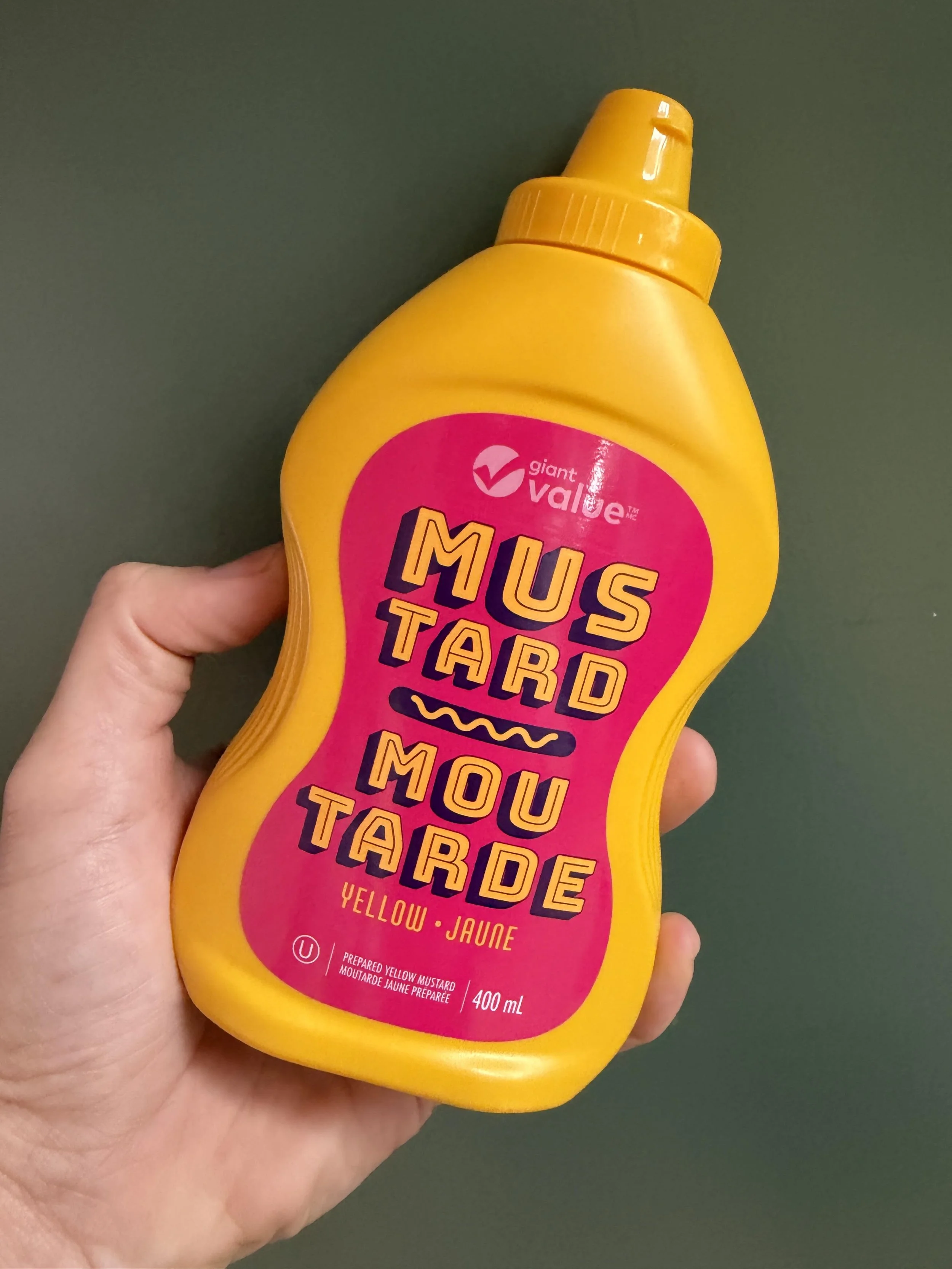
Last weekend I left Giant Tiger with a bottle of mustard that:
1) I did not need
2) I had never tried before.
Today, noticing it in the cupboard, I thought to myself 'Why?' Without an immediate answer I found myself inadvertently interviewing myself...
"What made you pick it up?"
There was something about the colors of the branding that I liked.
"Can you be more specific?"
The yellow and pink combination is not something you see a lot on shelves. I also liked how they broke up the word mustard. It didn’t feel like a generic brand.
"What makes something feel like a generic brand?"
Usually the branding is very white-label and lacks character. This has personality which I don't normally expect.
"What do you expect it to taste like if it doesn't feel like a generic brand?"
There are generic products that are good quality, but if it’s something I haven’t tried before, I tend to expect the quality to be a bit lower than a brand-name product. So part of me thought if the label looks a little nicer, maybe the product will be too.
"And what made you decide to put it in your cart?"
It was $1.50! Well worth the risk.
"Are you done being interviewed by yourself yet?"
Yes. When will I be receiving my incentive?
My key takeaway?
Distinctive aesthetic choices can be enough to nudge a first-time purchaser from noticing a product to putting it in their cart.
As for becoming a repeat customer? That will have to wait until my product testing focus group with the kids.
In the meantime, let's consider giving the marketing team at Giant Tiger a raise 👏.
I conducted an IDI with myself on why I bought mustard 🟡.
Previous
Previous
Announcing Fraser Insights
Next
Next